
Lamborghini Insecta

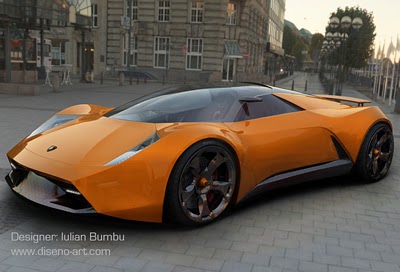
The Lamborghini Insecta concept was created by Iulian Bumbu, a Romanian designer who in 2008 completed the Transportation Design Master Course with Alfa Romeo at the Scuola Politecnica di Design (SPD) in Milan.
The Insecta concept, as the name suggests, was partially inspired by the world of insects. In particular the armored casings which protect beetles. Viewed from the top and the rear this organic influence is most apparent. And despite the fact that the common beetle shares little in common with the world of high performance supercars, the inspiration has been successfully translated and integrated into the overall design superbly. The concept manages to be fresh and interesting with angular yet sweeping lines which instantly identify the vehicle as a Lamborghini. The trademark scissor opening doors are an essential Lamborghini feature.
The dimensions of the Insecta concept are similar to that of the Lamborghini Gallardo, with the two sharing an identical overall length of 4300mm (169 inches). However the Insecta is lower and wider than the Gallardo with a slightly longer wheelbase. Powering the Insecta is the same 5.0 litre, V10 engine and drivetrain found in the Gallardo. The glass engine cover which seamlessly blends into the glass roof provides a clear view of the mid-mounted engine.
To help keep the weight down the bodywork of the Lamborghini Insecta is formed from carbon fibre. Some areas are left unpainted like the front air dam, sideskirts and rear valence and show of the bare carbon fibre weave. This feature also provides a nice contrast to the paintwork.
Inside the Lamborghini Insecta concept are a pair of deep bucket seats, a U-shaped sports steering wheel and a high center console which divides the passenger compartment in two.

HHave more information about this car than please comment us or email us at roadstrikersIN@gmail.com

Thank you
Popular posts from this blog

Maserati Ghibli vs BMW 6 Series : Which Will You Buy?

When considering vehicles like Maserati Ghibli and the BWM 6 Series Gran Coupe, both reflect an effort toward blending dignified luxury with exhilarating performance. Though beholding vehicles of this caliber is always an exercise most fruitfully left to the natural eye, the image above serves as a simple example of each sedan’s inherent dignity. In lieu of experiencing each vehicle’s performance profile from behind the wheel, the table provided similarly works to demonstrate what both Ghibli and BMW’s 6 series have been engineered to accomplish. Comparing the Maserati Ghibli vs. BMW 6 Series in this regard yields a number of important emphases. Local clients will notice that both vehicles develop their identity around six-cylinder engines with a pair of strategic turbochargers. Yet regardless of identical displacement and analogous induction technology, Maserati serves its Ghibli clients with significantly greater quantities of horsepower and torque. In addition to t...

McLaren 650S Sprint

McLaren’s new 650S model now comes in three flavors, the standard road going 650S, the competition-spec 650S GT3 for serious racers, and now there’s the 650S Sprint which is aimed at track enthusiasts who still want a little bit of comfort. The 650S Sprint also replaces the MP4-12C-based 12C Sprint as McLaren’s track toy for the super-rich. Compared to the road model, the 650S Sprint features increased downforce and better cooling airflow to the 3.8 litre twin-turbocharged V8. It also features a competition-spec fuel tank and quick-fill cap, a larger radiator borrowed from the GT3 car, a new hood with additional cooling ducts for the radiator, front wing louvres for improved airflow, reduced ride height and recalibrated damping and spring rates, 19-inch center-locking race wheels with either Pirelli slicks or wet tires, onboard air jack system, and an upgraded braking system. On the inside the McLaren 650S Sprint features a stripped-out design with a FIA-approved rol...

Lamborghini Canto – What the Murcielago could have been?

Back in the late 1990s, when Lamborghini were starting to realise they needed a replacement for the ageing Diablo, they started reviewing design proposals from various automotive design firms. Zagato’s offering was the Zagato L147 SuperDiablo, or as it was to be later known, the Lamborghini Canto. The Lamborghini Canto first appeared in 1998, it arrived only two years after another Zagato designed Lamborghini concept had been unveiled, the Diablo-based Raptor. The cars shared a number of similar features, including the wraparound windows, triangular lateral air intakes, and trademark double-bubble roof. However of the two, the earlier Raptor was probably the better looking. Clearly Ferdinand Piech – head of the Volkswagen Group – thought so too. After VW bought Lamborghini in 1999, one of his first decisions was to review the Canto’s development and redesign the concept. The car was re-engineered and the rear extensively restyled to include smaller air intakes....