
Lamborghini Insecta

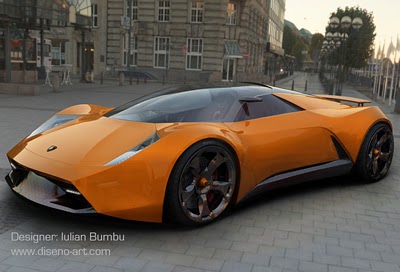
The Lamborghini Insecta concept was created by Iulian Bumbu, a Romanian designer who in 2008 completed the Transportation Design Master Course with Alfa Romeo at the Scuola Politecnica di Design (SPD) in Milan.
The Insecta concept, as the name suggests, was partially inspired by the world of insects. In particular the armored casings which protect beetles. Viewed from the top and the rear this organic influence is most apparent. And despite the fact that the common beetle shares little in common with the world of high performance supercars, the inspiration has been successfully translated and integrated into the overall design superbly. The concept manages to be fresh and interesting with angular yet sweeping lines which instantly identify the vehicle as a Lamborghini. The trademark scissor opening doors are an essential Lamborghini feature.
The dimensions of the Insecta concept are similar to that of the Lamborghini Gallardo, with the two sharing an identical overall length of 4300mm (169 inches). However the Insecta is lower and wider than the Gallardo with a slightly longer wheelbase. Powering the Insecta is the same 5.0 litre, V10 engine and drivetrain found in the Gallardo. The glass engine cover which seamlessly blends into the glass roof provides a clear view of the mid-mounted engine.
To help keep the weight down the bodywork of the Lamborghini Insecta is formed from carbon fibre. Some areas are left unpainted like the front air dam, sideskirts and rear valence and show of the bare carbon fibre weave. This feature also provides a nice contrast to the paintwork.
Inside the Lamborghini Insecta concept are a pair of deep bucket seats, a U-shaped sports steering wheel and a high center console which divides the passenger compartment in two.

HHave more information about this car than please comment us or email us at roadstrikersIN@gmail.com

Thank you
Popular posts from this blog

McLaren P2 by Rakesh

The McLaren P2 is a concept created by Rakesh Bag , a Student of The Aditya Birla Public School , Veraval , Gujarat from INDIA The styling of the McLaren P2 is more attractive and less clinical than the McLaren P1 , but you can bet your entire worldly possessions on the fact every last millimetre of the bodywork has been extensivley analysed in the windtunnel. The front is unique and original, the way lower part of the bumper flows back into the ‘C’ shaped headlights is inspired. And the P2’s rear end has got to be one of the best in the business. Stunning. “the McLaren P1 and P2 will be the result of 50 years of racing and road car heritage. Twenty years ago we raised the supercar performance bar with the McLaren F1 and our goal with the McLaren P1 and P2 is to redefine it once again.” “Our aim is not necessarily to be the fastest in absolute top speed but to be the quickest and most rewarding series production road car on a circuit,” adds McLaren Automotive Managing Director Anton...

Lamborghini Diamante

Thomas Granjard's Final year degree project at Coventry University Lamborghini Diamante University project (not developed with Lamborghini) Trailer We're in the year 2023. Oil is getting depleted on our planet. However, mobility will continue to exist, it needs to. Such mobility not only includes boring electric vehicles for the city but also supersportcars with alternative drive systems. Flat, fast, extreme – cars that still set everyone in the mood for mobility without having a bad conscience – such as the eco-friendly Diamante Concept Car. This concept combines exclusivity and extremes in one single supersportcar. The name says it all. The most valuable mineral in the world stands for luxury, but also for naturalness, pureness, hardness and beauty – exactly as the dream car with the white collar. Its extremely flat silhouette is flanked by sharply outlined edges, the curved surface appears to be unpolished, rough, precious. The aerodynamic system uses movable wings to ...

Ferrari FF

A new chapter in Ferrari’s rich history begins with this, the FF. The designation is simply shorthand for ‘Ferrari Four’, and not only is it a two-door 'shooting brake' estate, but for the first time ever a Ferrari has four-wheel drive capability. This new Ferrari FF sounds intriguing. Does it have conventional 4wd system? No. Instead the FF has a two-speed ‘box (plus reverse) mounted ahead of the engine that takes its drive directly from the crank. The ‘box drives the front wheels via wet clutches that can adjust the torque going to each front wheel independently (essentially by varying degrees of slip). No transfer diff, no connection to the rear wheels. The advantages are light weight, fast response time and, crucially, the ability to pre-empt wheelspin and start to help the rear tyres before they go beyond the limit of grip and traction. And in perfect conditions the FF should remain completely rear-driven to retain that agility so central to the mode...